
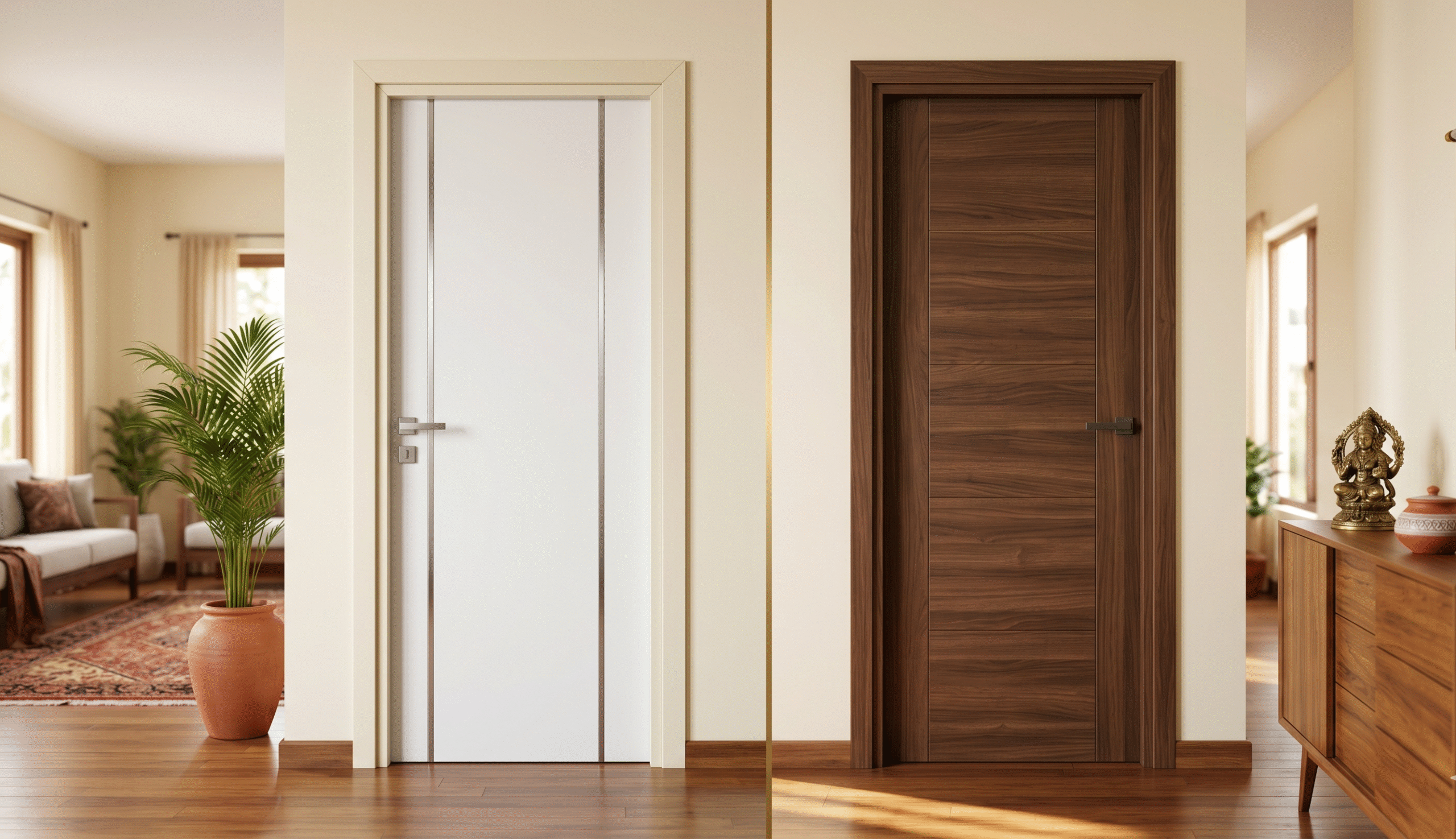
UPVC and ABS are the two most common modern door materials for Indian homes, and they’re frequently compared because they sit in similar price ranges and both promise waterproof, termite-proof, low-maintenance performance. But they’re not interchangeable. They use different polymer chemistry, different manufacturing processes, and different construction methods. The differences matter in specific use cases.
This guide compares UPVC and ABS doors across 10 practical dimensions, shows where each wins, and gives you a clear answer for bathrooms, main doors, kitchens, and other rooms.
What is a UPVC door?
UPVC stands for Unplasticised Polyvinyl Chloride. It’s a rigid form of PVC (the same plastic used in pipes) that doesn’t contain plasticisers, making it stiffer, more weather-resistant, and more suitable for doors and windows.
A typical UPVC door has:
– UPVC frame (extruded profile, hollow with internal ribs)
– UPVC panel or glass panel infill
– Steel reinforcement inside the frame for rigidity
– Rubber gaskets for weatherproofing
UPVC doors came up in Indian residential construction primarily in the early 2010s, alongside UPVC windows. They remain popular especially in Mumbai, Pune, and Bangalore for balcony and bathroom applications.
What is an ABS door?
ABS stands for Acrylonitrile Butadiene Styrene. It’s an engineering thermoplastic originally developed for aerospace and automotive applications. ABS sheets bonded to a rigid core create a door that combines the waterproof benefits of plastic with the structural feel of a traditional door.
A typical ABS door has:
– ABS sheet (typically 1.35 to 1.5 mm thick) on both faces
– Tubular or honeycomb core for structural rigidity
– LVL (Laminated Veneer Lumber) reinforcement at lock and hinge points
– ABS-wrapped frame matching the door
ABS is newer to Indian residential construction than UPVC but has grown rapidly because the finishes are more versatile (wood grain, pattern embossing, textured surfaces) while delivering the same waterproof performance.
UPVC vs ABS: 10-point comparison
1. Waterproof performance
UPVC: excellent initially. Over time, the rubber gaskets degrade and waterproofing becomes dependent on sealant maintenance.
ABS: excellent permanently. The ABS sheet is inherently waterproof with no degrading components.
Winner: ABS for long-term waterproofing.
2. Termite and pest resistance
UPVC: completely immune.
ABS: completely immune.
Winner: tie.
3. Thermal insulation
UPVC: good. Hollow chambers in the frame profile insulate well. But the visible profile is bulkier than ABS.
ABS: good. The internal core (honeycomb or tubular) acts as an insulating layer.
Winner: marginal edge to UPVC for very cold climates; otherwise tie.
4. Sound insulation
UPVC: moderate. Hollow profiles carry sound more than solid-core doors.
ABS: better. Solid core with ABS cladding dampens sound transmission more effectively.
Winner: ABS.
5. Design variety
UPVC: limited. Usually flat panels or glass infills. Limited colour options (mostly white, wood-laminate wraps).
ABS: extensive. Wood grain finishes, carved patterns, metal inlays, textured surfaces, louvred panels, glass inserts.
Winner: ABS, clearly.
6. Strength and durability
UPVC: strong thanks to steel reinforcement inside the frame. But the visible surface can crack or dent under direct impact.
ABS: highly impact-resistant. The ABS sheet flexes under impact and returns without marking.
Winner: ABS for impact.
7. Aesthetic quality
UPVC: reads as functional rather than premium. Even quality UPVC doors have a slightly utilitarian look.
ABS: wood-finish ABS doors look like real wood. Modern finishes read as premium.
Winner: ABS.
8. Price
UPVC: ₹8,000 to ₹15,000 for a standard bathroom door. ₹20,000 to ₹40,000 for main door options.
ABS: ₹8,000 to ₹22,000 for a standard bathroom door. ₹20,000 to ₹50,000 for main doors.
Winner: roughly equal. ABS offers slightly better value per rupee when comparing like-for-like.
9. Maintenance
UPVC: periodic. Gasket inspection and replacement every 3 to 5 years. Occasional sealant reapplication.
ABS: zero. Wipe with a damp cloth. No gaskets to replace.
Winner: ABS.
10. Climate suitability
UPVC: performs well in most Indian climates but gaskets degrade faster in coastal and tropical humid climates.
ABS: performs consistently across all Indian climates including coastal Mumbai, Chennai, Kochi, and Goa.
Winner: ABS for coastal and high-humidity regions.
Quick summary table
| Feature | UPVC | ABS |
|---|---|---|
| Waterproof | Good (degrades over time) | Excellent (permanent) |
| Termite proof | Yes | Yes |
| Impact resistance | Medium | High |
| Thermal insulation | Good | Good |
| Sound insulation | Moderate | Better |
| Design variety | Limited | Extensive |
| Wood-finish available | Via laminate wrap | Native manufacture |
| Maintenance | Periodic (gaskets) | Zero |
| Aesthetic quality | Functional | Premium |
| Climate suitability | Good | Excellent |
| Typical price (bathroom) | ₹8,000 to ₹15,000 | ₹8,000 to ₹22,000 |
| Lifespan | 10 to 15 years | 15 to 20 years |
Which is better for bathrooms?
ABS wins for bathrooms. Here’s why:
- The rubber gaskets on UPVC doors are the weakest waterproof element. In bathroom conditions (daily humidity, steam, cleaning chemicals), these gaskets degrade faster than in any other room.
- ABS has no gaskets on the door surface. The material itself is waterproof, so there’s nothing to degrade.
- Wood-finish ABS bathroom doors look more premium and match bedroom doors aesthetically better than UPVC.
For bathroom doors specifically, see our complete best bathroom doors buyer’s guide.
Which is better for main doors?
ABS wins for main doors. Reasons:
- Design variety: main doors benefit from wood-finish, metal inlay, carved patterns. UPVC is limited to flat panels.
- Impact resistance: main doors face occasional impact (kids, moving furniture, delivery people). ABS handles this better.
- Smart lock compatibility: smart locks require solid material to hold mounting screws long-term. ABS works better than hollow UPVC profiles.
- Aesthetic: main doors are the face of your home. ABS looks more premium.
UPVC main doors exist and work, but they’re a utility choice rather than a design choice.
Where UPVC wins or matches ABS
UPVC holds its own or wins in some contexts:
- Balcony sliding doors (large glazed sliding installations): UPVC is the standard because the steel-reinforced frame handles the wide spans better than ABS for sliding applications.
- Windows paired with doors: if you’re installing UPVC windows, matching UPVC balcony doors gives visual consistency.
- Very budget-constrained projects: UPVC starts slightly cheaper at the entry tier.
- Cold climates (Shimla, Gangtok, Dehradun): UPVC’s slightly better thermal insulation matters.
15-year cost comparison
For a standard bathroom door:
UPVC bathroom door (₹12,000 initial):
– Year 0: ₹12,000 initial
– Year 5: ₹2,500 gasket replacement
– Year 10: ₹2,500 gasket replacement plus ₹1,500 hardware check
– Year 15: possible replacement needed
– Total 15-year cost: ₹18,500
ABS bathroom door (₹14,000 initial):
– Year 0: ₹14,000 initial
– Zero maintenance through year 15
– Covered under 10-year warranty
– Total 15-year cost: ₹14,000
Despite costing ₹2,000 more upfront, the ABS door is ₹4,500 cheaper over 15 years because of zero maintenance.
Why Kassa chose ABS over UPVC for its product line
Kassa is a specialist ABS door manufacturer. The reasoning:
- Korean ABS sheet technology delivers consistent finish quality that UPVC laminate wraps can’t match
- German tubular core provides sound insulation and structural rigidity that hollow UPVC profiles don’t
- Zero-maintenance claim holds true across all climates, unlike UPVC which needs gasket attention
- Wood-finish options look genuinely like wood, vs UPVC laminate which reads as plastic
For comparisons with other materials, see our guides on aluminium vs ABS doors and wooden vs ABS doors.
Frequently Asked Questions
Is UPVC better than ABS?
UPVC is better for large sliding balcony doors and cold-climate insulation. ABS is better for bathroom doors, main doors, kitchens, and virtually all residential applications where design variety, impact resistance, and zero maintenance matter.
Is UPVC waterproof like ABS?
UPVC is waterproof initially, but its waterproofing depends on rubber gaskets that degrade over 3 to 5 years. ABS is inherently waterproof through its material composition with no degrading components.
Which is cheaper, UPVC or ABS?
At the entry tier, UPVC and ABS are similarly priced. For premium tiers, ABS offers slightly better value per rupee because of longer lifespan and zero maintenance costs. Over 15 years, ABS is typically the cheaper total cost.
Can UPVC doors be used for main entrance?
Yes, but they’re less common than ABS or wood for main entrances. UPVC main doors look utilitarian and have limited design options. Most homeowners choose ABS or solid wood for main doors where aesthetic presence matters.
Do UPVC doors look cheap?
UPVC doors have a functional appearance that’s not as premium as wood-finish ABS. The laminate wraps used to give UPVC a wood look often show seams and don’t age as gracefully as native-wood-finish ABS sheets.
Which is more eco-friendly, UPVC or ABS?
Both are recyclable. UPVC uses chlorine compounds in manufacturing, which has environmental concerns. ABS is considered slightly more eco-friendly but neither is comparable to sustainably harvested wood or fibreglass.
How long does a UPVC door last?
UPVC doors typically last 10 to 15 years before gasket degradation, frame wear, or glass panel issues require significant work. ABS doors typically last 15 to 20 years with most manufacturers offering 10-year replacement warranties.
Can I mix UPVC and ABS doors in the same home?
Yes, and it’s common. Many homeowners use UPVC for balcony sliding doors (UPVC’s strength) and ABS for bathroom, bedroom, and main doors (ABS’s strength). The combination plays to each material’s advantages.
Choosing between UPVC and ABS for your home? A Kassa design consultant can help you pick the right door for each room based on your specific use case and climate. Call +91 93848 57732, email info@kassaent.com, or visit kassadoors.com. Available in Chennai, Bengaluru, Kochi, and Hyderabad.