
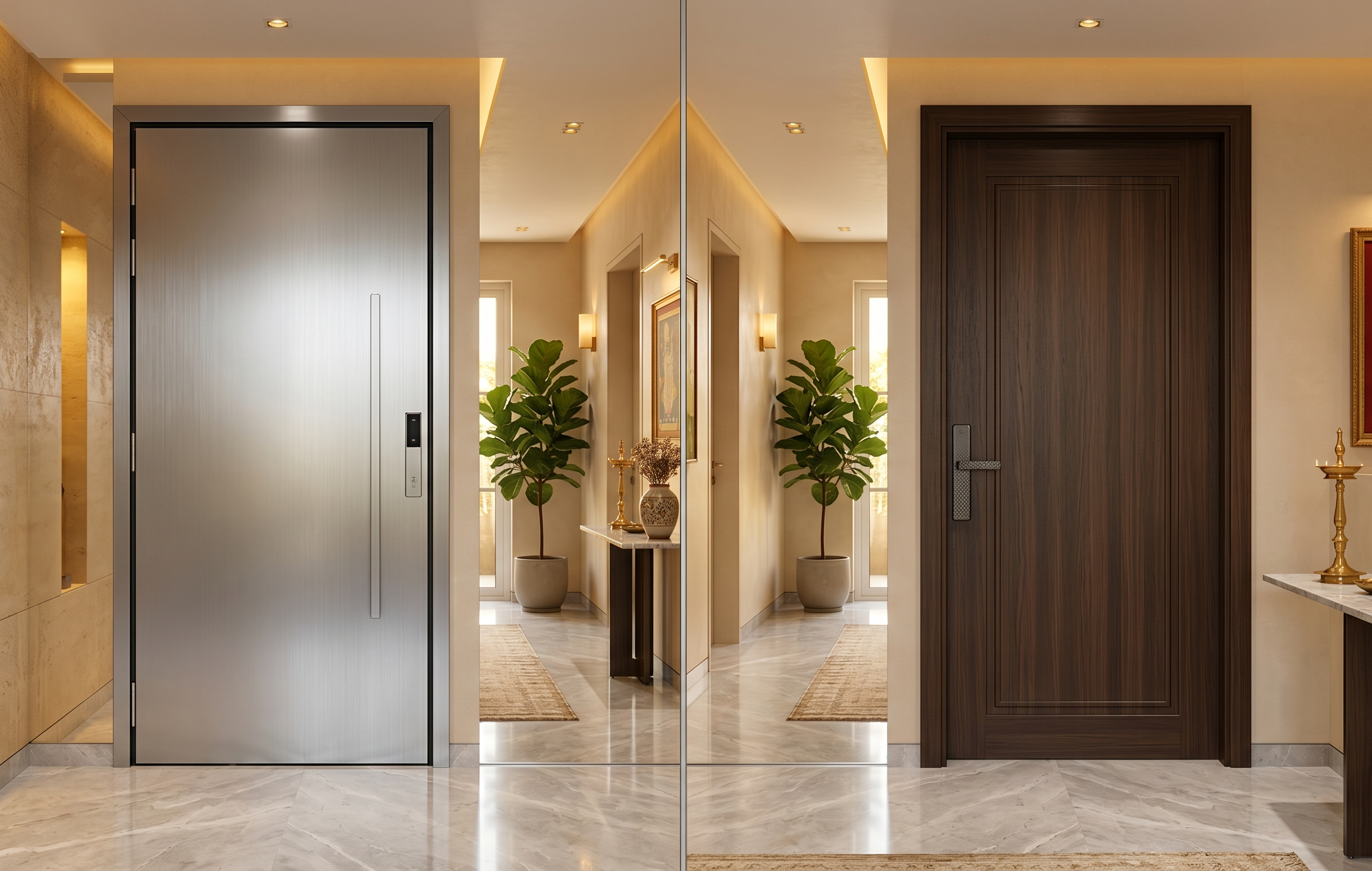
If you are renovating a bathroom, designing a kitchen, or picking doors for a new apartment, you have probably narrowed it down to two materials that keep coming up: aluminium doors and ABS doors. Both are marketed as modern, durable, and low-maintenance alternatives to traditional wood. But they serve different use cases, carry different trade-offs, and cost different amounts.
This guide compares aluminium doors vs ABS doors across 10 practical dimensions so you can pick the right one for your specific room and budget.
What is an aluminium door?
An aluminium door is built around an extruded aluminium frame, usually infilled with glass panels, aluminium sheet, or occasionally ACP (aluminium composite panel). Aluminium doors came up in Indian residential construction primarily through two routes: as balcony sliding doors (replacing old steel shutters) and as modern minimalist interior doors for designer apartments.
Popular use cases:
– Balcony sliding doors
– Bathroom doors in modern apartments
– Kitchen-to-utility pantry doors
– Office partition doors
Typical construction:
– Aluminium frame (usually 40mm to 60mm profile)
– Glass, aluminium sheet, or louvred infill
– Rubber gaskets for weatherproofing
– Hinged or sliding operation
What is an ABS door?
An ABS door is built around a Honeycomb or Tubular core wrapped in an ABS (Acrylonitrile Butadiene Styrene) sheet. ABS is an engineering thermoplastic originally developed for aerospace and automotive applications. In doors, it provides a hard, waterproof, termite-proof outer skin with a dimensionally stable core inside.
Popular use cases:
– Bathroom doors
– Kitchen doors
– Bedroom doors
– Main entrance doors (premium grades)
– Hospital and institutional doors
Typical construction:
– Korean-manufactured ABS sheet (1.35mm to 1.5mm thickness)
– German tubular or honeycomb core
– LVL (Laminated Veneer Lumber) reinforcement around lock and hinge points
– ABS-wrapped or aluminium frame
Aluminium doors vs ABS doors: 10-point comparison
1. Waterproof performance
Aluminium: waterproof in theory, but the rubber gaskets degrade over time and leaks develop at joints. Fully glazed aluminium doors also allow condensation to run down inside the frame.
ABS: 100% waterproof by material design. No gaskets required for the door surface itself, only at the frame-wall joint. No degradation over time.
Winner: ABS, especially for bathrooms and kitchens.
2. Termite and pest resistance
Aluminium: completely immune. Termites cannot touch metal.
ABS: completely immune. ABS is a synthetic polymer that termites ignore.
Winner: Tie. Both are termite-proof.
3. Durability against impact
Aluminium: dents on moderate impact. A child ramming a toy truck will leave a visible dent. Scratches are common and visible on satin finishes.
ABS: highly impact-resistant. The ABS sheet flexes and returns. Daily household impact does not leave marks.
Winner: ABS for high-traffic family homes.
4. Weight and ease of handling
Aluminium: very lightweight, easy to install, minimal strain on hinges.
ABS: moderately light (lighter than wood, heavier than aluminium). Easy to install but needs proper hinges for bedroom and main doors.
Winner: Aluminium marginally, but ABS is close.
5. Thermal and sound insulation
Aluminium: poor thermal insulator. Metal conducts heat and cold, so aluminium doors in direct sunlight or AC proximity create thermal transfer. Poor sound insulation too because glass panels are acoustically weak.
ABS: good thermal insulation because of the air-filled core. Good sound insulation (the honeycomb or tubular core dampens sound transmission).
Winner: ABS clearly.
6. Design variety
Aluminium: limited. Slim profile, glass, mesh, or louvre infill. Modern industrial look. Not available in wood-grain or carved designs.
ABS: extensive. Wood-grain finishes, carved patterns, strip accents, glass inserts, louvre designs, plain flush, textured finishes. Almost any look is achievable.
Winner: ABS for design flexibility.
7. Maintenance
Aluminium: periodic cleaning required. Dust accumulates on the frame profile. Rubber gaskets need inspection and replacement every 3 to 5 years.
ABS: zero maintenance. Wipe with damp cloth. No gaskets to replace.
Winner: ABS.
8. Price
Aluminium: ₹10,000 to ₹25,000 for a standard bathroom door including installation. Sliding balcony doors can run ₹25,000 to ₹60,000 depending on size and glass spec.
ABS: ₹8,000 to ₹22,000 for a standard bathroom door. Main doors ₹15,000 to ₹45,000. Double doors ₹35,000 to ₹90,000.
Winner: roughly even for standard sizes. ABS offers better value per rupee when comparing like-for-like.
9. Ideal climate and location
Aluminium: performs best in dry, moderate climates. Struggles in high-humidity coastal regions (gasket degradation) and in areas with large temperature swings (thermal expansion can cause frame warping over 10+ years).
ABS: performs consistently across all Indian climates. Tropical coastal humidity, monsoon regions, and dry northern climates all work.
Winner: ABS for the Indian context overall.
10. Aesthetic fit
Aluminium: suits modern, industrial, and minimalist interiors. Feels cold if used in traditional, heritage, or Indo-colonial homes.
ABS: versatile, with wood-finish options that fit traditional aesthetics and clean flush options that fit modern ones.
Winner: ABS for versatility, aluminium for strict modern-industrial aesthetic.
Quick comparison table
| Feature | Aluminium Doors | ABS Doors |
|---|---|---|
| Weight | Very light | Moderately light |
| Impact resistance | Medium (dents) | High |
| Waterproof | Good (degrades over time) | Excellent (permanent) |
| Termite proof | Yes | Yes |
| Thermal insulation | Poor | Good |
| Sound insulation | Poor | Good |
| Design variety | Limited | Extensive |
| Wood-grain finish available | No | Yes |
| Maintenance | Medium (gaskets) | Zero |
| Ideal climate | Dry, moderate | All Indian climates |
| Typical price (bathroom) | ₹10,000 to ₹25,000 | ₹8,000 to ₹22,000 |
| Typical lifespan | 10 to 15 years | 15 to 20 years |
When to choose aluminium doors
Aluminium still wins in specific situations:
- Large sliding balcony doors with full-height glazing. This is aluminium’s core strength.
- Commercial shopfronts where the industrial aesthetic is intentional.
- Frameless glass doors for designer interiors where you want the glass to be the hero.
- Very minimalist modern homes where matte black or anodised aluminium profiles match the overall design language.
- Partitions in offices and workspaces.
When to choose ABS doors
ABS is the better choice in most residential applications:
- Bathrooms and kitchens: the humidity resistance advantage is decisive.
- Bedroom and main doors: design flexibility, sound insulation, and security all favour ABS.
- Kids’ rooms: impact resistance matters.
- High-humidity locations: Chennai, Mumbai, Kerala, Goa, Kolkata, all of coastal India.
- Homes with elderly members: ABS is quieter and safer.
- Long-term value buyers: lower lifetime cost because of zero maintenance.
The hybrid approach that works well
Many smart homeowners in 2026 are using aluminium and ABS together:
- Aluminium for the balcony sliding door (best use of aluminium)
- ABS for all bathroom, bedroom, kitchen, and main doors (best use of ABS)
This plays to each material’s strengths and gives the best overall home.
What about price over 15 years?
Upfront price is only part of the picture. Here is a realistic 15-year cost comparison for a standard bathroom door.
Aluminium bathroom door:
– Initial cost: ₹18,000
– Gasket replacement at year 5: ₹2,500
– Gasket replacement at year 10: ₹2,500
– Possible hinge replacement at year 12: ₹1,500
– 15-year total: ₹24,500
ABS bathroom door:
– Initial cost: ₹15,000
– Zero maintenance required
– Covered under 10-year warranty
– 15-year total: ₹15,000
The ABS door costs ₹9,500 less over its lifetime despite costing slightly more per year of guaranteed coverage.
Frequently Asked Questions
Are aluminium doors better than ABS doors?
Aluminium is better for large sliding balcony doors and frameless glass applications. ABS is better for bathroom, kitchen, bedroom, and main doors in Indian homes because it offers superior waterproofing, impact resistance, thermal insulation, and design flexibility.
Which is more affordable, aluminium or ABS doors?
For comparable sizes and specifications, ABS and aluminium cost similar amounts upfront. However, ABS has a lower 15-year total cost because it requires zero maintenance while aluminium needs periodic gasket and seal replacement.
Are aluminium doors good for bathrooms?
Aluminium doors work for bathrooms but degrade over time. The rubber gaskets that keep them waterproof fail after 3 to 5 years and require replacement. For long-term performance in Indian humidity, ABS is a better match for bathroom use.
Do ABS doors look cheap compared to aluminium?
No. Modern wood-finish ABS doors look like premium wood and carry no plastic-y appearance. Aluminium has a modern industrial look which some homeowners love and others find cold. It comes down to aesthetic preference, not quality.
Can ABS doors be used as main doors?
Yes. Premium-grade ABS doors with reinforced frames and multi-point locking are designed specifically for main entrances. Kassa’s Premium Door series is built for this use case with 10-year replacement warranty.
Which material is more eco-friendly?
Both are recyclable. Aluminium is infinitely recyclable with high existing recycling infrastructure. ABS is also recyclable but recycling infrastructure for ABS is less developed in India. Both outperform traditional wood on the deforestation dimension.
Do aluminium doors rust?
Aluminium does not rust in the traditional iron-oxidation sense. However, it can develop white oxidation spots in high-salt coastal environments if the protective anodised layer is damaged. ABS has no equivalent issue.
What is the typical lifespan of each?
Aluminium doors typically last 10 to 15 years before gasket issues, frame wear, or glass replacement become necessary. ABS doors typically last 15 to 20 years with most manufacturers offering a 10-year replacement warranty.
Still unsure which is right for your home? Kassa’s design consultants can help you pick the right door for each room based on your specific climate, usage, and aesthetic. Book a free consultation at +91 93848 57732, email info@kassaent.com, or visit kassadoors.com.