
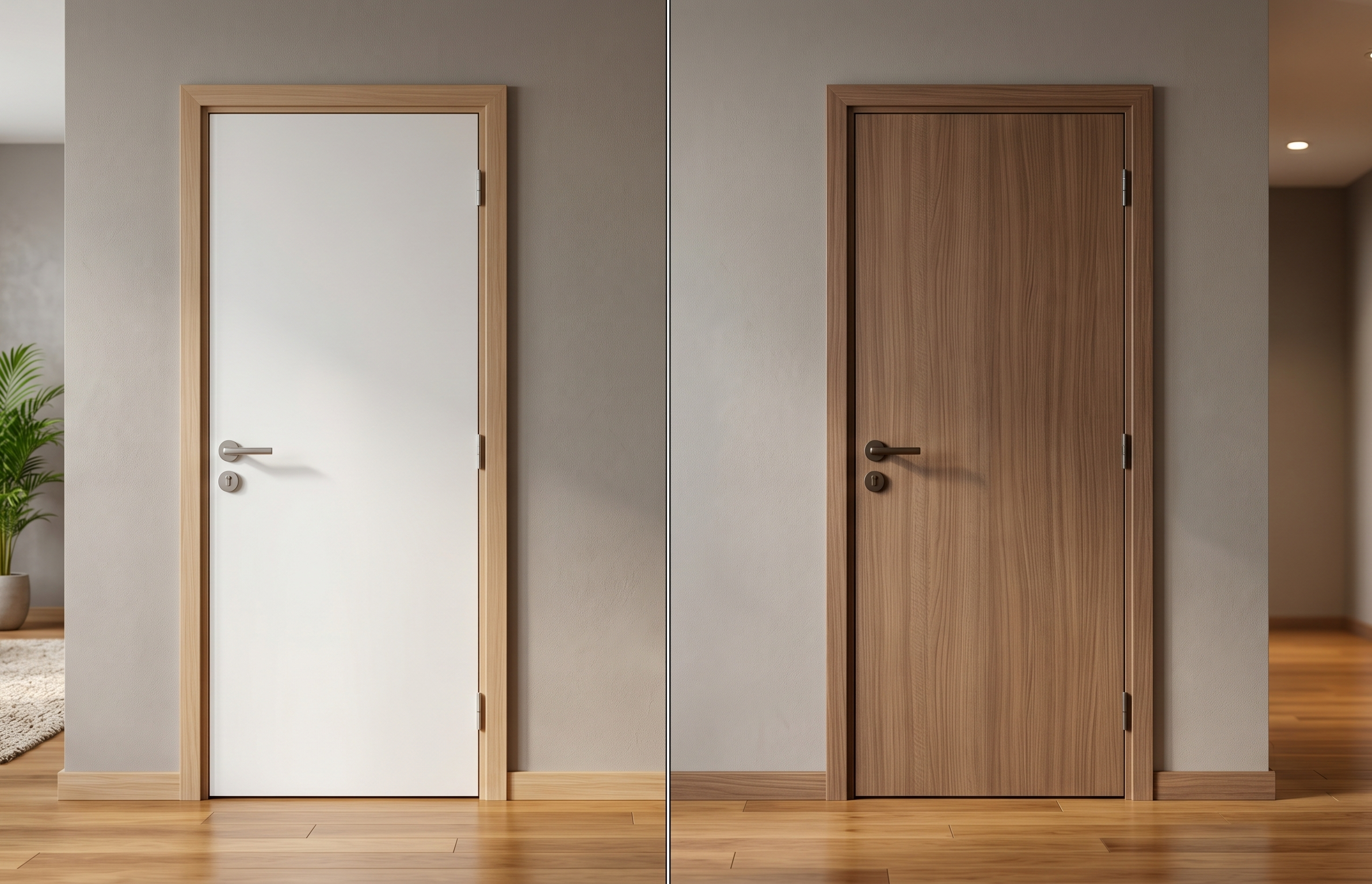
PVC doors and ABS doors both use polymer-based construction, both claim to be waterproof and termite-proof, and both sit in similar price territory at the budget tier. But they are fundamentally different materials, and the difference shows up sharply over 5 to 10 years of use. If you’re deciding between PVC and ABS for a bathroom, kitchen, or budget main door, this guide lays out the real differences.
What is a PVC door?
PVC stands for Polyvinyl Chloride. It’s the same plastic used in pipes, flexible furniture sheets, and inflatable products. For doors, PVC sheets are typically extruded or moulded into door panels with internal ribbing for structural strength.
A typical PVC door has:
– PVC sheet panel (usually 15 to 25 mm thick)
– Internal ribbed structure
– PVC or aluminium frame
– Basic hinge and lock hardware
PVC doors are the cheapest plastic doors available in the Indian market. They’re common in budget apartments, rental properties, staff quarters, and utility applications.
What is an ABS door?
ABS stands for Acrylonitrile Butadiene Styrene. It’s an engineering-grade thermoplastic with significantly higher impact resistance and heat tolerance than PVC. For doors, ABS sheets are bonded to a rigid internal core (honeycomb or tubular) to create a solid, premium-feeling door.
A typical ABS door has:
– ABS sheet skin (typically 1.35 to 1.5 mm) on both faces
– Tubular or honeycomb solid-feel core
– LVL reinforcement at lock and hinge points
– ABS-wrapped or metal frame
The key distinction: PVC doors are typically hollow or ribbed. ABS doors are solid-feeling with a proper core. This explains most of the practical differences.
PVC vs ABS: 10-point comparison
1. Price
PVC: ₹3,500 to ₹8,000 for a standard bathroom door. Cheapest modern door category.
ABS: ₹8,000 to ₹22,000 for a standard bathroom door. Mid to premium range.
Winner: PVC on upfront cost.
2. Material thickness and feel
PVC: thin walls with internal ribbing. The door feels hollow. Knock it and it sounds drummy.
ABS: thick ABS skin on a solid core. Feels like a real door. Knock it and it sounds solid.
Winner: ABS on feel.
3. Durability and lifespan
PVC: 5 to 8 years typically. Tends to yellow, crack under impact, and warp in extreme heat.
ABS: 15 to 20 years typically. Maintains colour, resists impact, stable through temperature variations.
Winner: ABS, significantly.
4. Waterproof performance
PVC: waterproof. This is its main advantage.
ABS: waterproof. Same performance.
Winner: tie on waterproofing.
5. Termite and pest resistance
PVC: immune.
ABS: immune.
Winner: tie.
6. Impact resistance
PVC: low. A kid ramming a toy, a dropped bucket, or a hard slam can crack or dent PVC doors permanently.
ABS: high. The ABS skin flexes under impact and returns without marking. The solid core absorbs impact without structural damage.
Winner: ABS, significantly.
7. Visual appearance
PVC: reads as plastic. Even textured PVC doors have a plastic-y sheen that’s hard to hide. Usually available in white, beige, or limited wood-printed finishes.
ABS: reads as premium. Wood-finish ABS looks like real wood. Modern finishes, carved patterns, and metal inlays are all possible.
Winner: ABS, significantly.
8. Strength and security
PVC: low. Hollow structure means screws for locks and hinges don’t hold reliably over time. Replacement of hardware is frequently needed.
ABS: high. LVL reinforcement at hardware points means locks and hinges stay tight for the door’s lifetime.
Winner: ABS.
9. Yellowing and UV resistance
PVC: commonly yellows over 3 to 5 years, especially when exposed to sunlight. A white PVC door may turn cream or pale yellow over time.
ABS: stable colour. Maintains factory appearance for the life of the door.
Winner: ABS.
10. Sound insulation
PVC: poor. Hollow doors transmit sound easily. Not good for bedrooms, master toilets, or anywhere privacy matters.
ABS: good. Solid core dampens sound transmission.
Winner: ABS.
Quick comparison table
| Feature | PVC | ABS |
|---|---|---|
| Price (bathroom door) | ₹3,500 to ₹8,000 | ₹8,000 to ₹22,000 |
| Feel | Hollow, drummy | Solid |
| Lifespan | 5 to 8 years | 15 to 20 years |
| Waterproof | Yes | Yes |
| Termite proof | Yes | Yes |
| Impact resistance | Low | High |
| Appearance | Plastic-y | Premium wood-like |
| Hardware reliability | Weak | Strong |
| Yellowing | Common after 3-5 years | Stable |
| Sound insulation | Poor | Good |
| Best for | Rentals, staff quarters, utility | Residential, quality-conscious homes |
10-year cost comparison: PVC vs ABS
The upfront cost difference between PVC and ABS seems significant, but the total cost over 10 years tells a different story.
PVC bathroom door path (₹5,000 initial):
– Year 0: ₹5,000 initial door
– Year 3: ₹1,500 lock replacement (failed)
– Year 5: ₹2,000 hinge and handle replacement
– Year 7: ₹5,000 full door replacement (cracked, yellowed)
– Year 10: door is 3 years into new cycle
– Total 10-year cost: ₹13,500, plus the inconvenience of 2 full replacements
ABS bathroom door path (₹12,000 initial):
– Year 0: ₹12,000 initial door
– Zero maintenance for 10 years
– Still covered by warranty at year 10
– Total 10-year cost: ₹12,000
ABS is actually cheaper over 10 years, delivers a better-looking door throughout, and eliminates the disruption of mid-life replacements.
When PVC is the right choice
PVC isn’t always wrong. Here’s where it genuinely fits:
- Rental properties where tenant turnover is high: you don’t need to invest in a 15-year door when tenants change every 18 months.
- Staff quarters and utility rooms: appearance isn’t important.
- Storage rooms: no one cares what a storage door looks like.
- Temporary construction or transitional accommodation: cheapest adequate option.
- Very tight budget where ABS isn’t feasible: something is better than nothing.
When ABS is the right choice
ABS is the right choice for most residential applications:
- All permanent residence bathrooms: you’ll spend 10+ years with the door. Spend well once.
- Kitchen doors: humidity, impact, oil splatter, all favour ABS.
- Bedroom doors: sound insulation and premium feel matter here.
- Main doors: impact, security, and aesthetics all favour ABS.
- Pooja room doors: low-usage spaces where termites accelerate on wood; ABS solves this permanently.
- Children’s bedrooms: impact resistance matters.
Visual test: how to spot PVC vs ABS doors in a showroom
If you’re in a showroom comparing doors, use these checks:
- Knock test: PVC sounds drummy and hollow. ABS sounds solid.
- Weight test: lift the door (or ask the salesperson to tilt it). PVC feels noticeably lighter for the same size.
- Edge test: look at the cross-section (usually visible in showroom samples). PVC shows hollow chambers or thin ribbing. ABS shows a solid core.
- Surface tap test: tap the surface firmly. PVC gives slightly under firm pressure. ABS doesn’t.
- Finish test: examine the wood grain closely. PVC wood prints often show repeating patterns. ABS wood-finish grain doesn’t repeat within the door width.
Why Kassa specialises in ABS, not PVC
Kassa chose to build its product line exclusively on ABS rather than PVC for several reasons:
- The 10-year replacement guarantee isn’t feasible to offer on PVC doors because PVC genuinely doesn’t last that long in Indian conditions
- ABS delivers a premium feel that meets the expectations of homebuyers in the ₹60 lakh+ apartment segment
- Korean ABS sheet technology allows finish quality that PVC can’t match
- Kassa’s customer research consistently showed buyers regretting PVC purchases within 5 years
For detailed material comparisons, see our UPVC vs ABS and aluminium vs ABS guides.
Frequently Asked Questions
Is PVC or ABS better for doors?
ABS is better for virtually all permanent residential door applications. It’s more durable, looks more premium, feels more solid, and lasts 2 to 3 times longer than PVC. PVC is only preferable when the budget is very constrained or the application is temporary.
Are PVC doors waterproof like ABS doors?
Yes, both PVC and ABS are waterproof. The difference isn’t in waterproofing but in overall durability, feel, appearance, and lifespan.
Why does PVC cost less than ABS?
PVC is a commodity plastic with lower material cost than engineering-grade ABS. PVC door manufacturing uses simpler processes with hollow or ribbed construction, whereas ABS doors require sheet-on-core bonding which is more complex and expensive.
Do PVC doors yellow over time?
Yes, PVC commonly yellows within 3 to 5 years especially when exposed to sunlight or in warm environments. White PVC doors in south-facing locations often discolour noticeably. ABS doors don’t have this issue.
Can PVC doors be used for main entrance?
Technically yes, but PVC main doors are generally not recommended. They lack the impact resistance, security strength, and aesthetic presence expected for main entrances. Most manufacturers (including Kassa) only make ABS or solid wood main doors.
How long do PVC doors last in Indian conditions?
PVC doors typically last 5 to 8 years in regular residential use before showing significant wear, yellowing, or structural issues. Heavy-use doors (main doors, high-traffic bathrooms) may degrade faster. ABS doors last 15 to 20 years in the same conditions.
Can I tell PVC from ABS by looking?
Sometimes, but not always. The knock test (drummy vs solid) is the most reliable quick check. Examining the cross-section at a door edge shows hollow chambers (PVC) vs solid core (ABS). If a door is marketed as “plastic” or “waterproof plastic,” it’s probably PVC; if it’s specified as ABS with a core type (tubular or honeycomb), it’s genuine ABS.
Which is better for bathrooms, PVC or ABS?
ABS is better for bathrooms in almost every case. It looks more premium, feels more solid, handles impact better, doesn’t yellow, and offers stronger hardware holding for hinges and locks. PVC bathroom doors are acceptable only for the tightest budgets or temporary accommodations.
Shopping for a new bathroom or interior door? Kassa offers an ABS door range starting around ₹8,000 with 10-year warranty, delivered across Indian cities. Call +91 93848 57732, email info@kassaent.com, or visit kassadoors.com. Available in Chennai, Bengaluru, Kochi, and Hyderabad.