
Your front door is the first thing guests see, the first line of defence for your home, and in Vastu tradition, the channel through which prosperity enters. Whether you call it the main door, the house front door, or the main entrance door, the design choice you make will shape how your home feels for the next decade or more.
This guide covers 10 trending front door design ideas for Indian homes in 2026, the materials that hold up best in Indian conditions, Vastu guidance for placement and colour, and the features that separate a door worth ₹15,000 from one worth ₹50,000.
Why your front door design matters more than you think
A well-chosen main door design affects three things that most homeowners underestimate:
- Curb appeal and property value. Real estate data consistently shows that upgrading an old or generic main door is one of the highest ROI renovations, second only to kitchen and bathroom updates.
- Security. Over 70% of break-ins in urban Indian apartments enter through the main door. Frame construction, lock quality, and material strength all matter.
- Vastu and energy flow. In traditional Indian homes, the main entrance is considered the mouth of the house. Its orientation, colour, and style carry deep cultural weight.
The good news: modern materials and manufacturing techniques now let you get all three right without compromising on budget.
10 front door design ideas for Indian homes in 2026
1. Minimalist Flush Door with Groove Accents
Clean vertical or horizontal grooves carved into a flush door surface. Looks premium without looking busy. Works beautifully in modern apartments and contemporary villas. Pair with a matte black or brushed gold handle for a quiet statement.
Best for: 2BHK and 3BHK apartment main doors where you want a modern look without overwhelming a compact landing area.
2. Rustic Wood-Look ABS Door
You get the warmth and grain of real teak or walnut without the termite, monsoon, and maintenance issues. High-quality wood-finish ABS doors are so convincing that visitors genuinely cannot tell the difference by looking. Swipe a cool hand across the surface, though, and the temperature feel gives it away. That is the only tell.
Best for: homeowners who love traditional aesthetics but have had bad experiences with wooden doors swelling or cracking.
3. Grand Double Door Entrance
For independent houses, villas, and bungalows with wider entrance spans, a symmetrical pair of doors transforms the entry into an event. You can specify equal width (60/60) or one active and one passive leaf (70/30) for everyday use while keeping the option to open both for festivals, weddings, or moving furniture.
Best for: plots above 1,200 sqft, heritage-inspired homes, and any home where the entrance is visible from the street.
See our complete guide on double door designs and advantages for deeper coverage.
4. Geometric Statement Door
Bold chevrons, interlocking triangles, or Art Deco patterns carved or embossed onto the door surface. These work best against a neutral exterior wall because the door itself carries the visual interest.
Best for: architect-designed homes, boutique villas, and owners who want their main door to be the photograph.
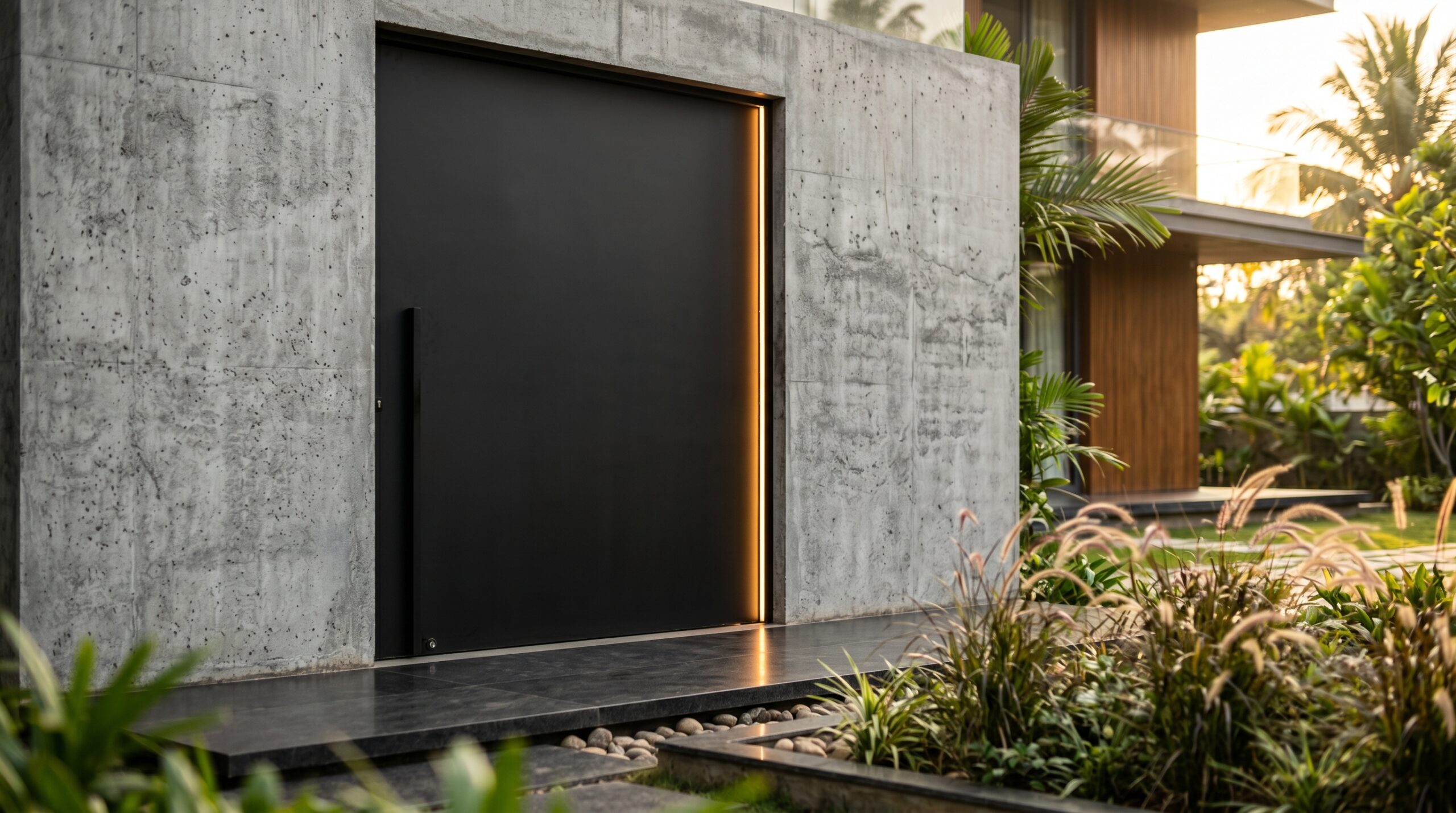
5. Pivot Door
Instead of hinges on the side, a pivot door rotates on a top-and-bottom axis, creating a dramatic reveal when opened. Allows for oversized doors (8 to 10 feet tall) that would not be structurally possible with traditional hinges. Still rare in Indian homes, which is why it stands out.
Best for: luxury villas, show homes, and any project where the entrance is the design hero.
6. Textured Finish Door
Concrete-look, leather-embossed, stone-textured, or metallic-coated finishes bring a tactile dimension to your entryway. These read as premium because texture is expensive to fake in photos, so only high-end doors carry it.
Best for: modern minimalist homes where you want depth without pattern, and coastal properties where traditional wood grain would look out of place.
7. Bold Colour Pop Door
A vibrant front door (deep teal, burgundy, mustard yellow, forest green, or classic Indian red) against a neutral exterior wall is one of the highest-impact curb appeal moves you can make. Small investment, huge visual return. Ensure the colour is UV-stable and will not fade in Indian sun.
Best for: row houses, independent homes with plain walls, and anyone who wants personality without overhauling the house.
Check our guide on door colour ideas and combinations for 30+ specific palette suggestions.
8. Glass Panel Door with Privacy Glass
Full-height or partial glass panels that let in natural light while maintaining privacy through frosting, fluting, or patterned etching. Transforms dark apartment corridors into bright, welcoming entries. The glass must be tempered for safety and properly framed against monsoon water ingress.
Best for: apartment main doors where the corridor is dark, and modern homes where you want indoor-outdoor visual flow.
9. Double Door with Ventilator Window
A traditional Indian design updated for 2026: a pair of solid doors topped with a horizontal ventilator window (often frosted or grilled). Gives you the grandeur of a double door plus ventilation when you want it.
Best for: independent houses in South India and coastal regions where cross-ventilation matters.
10. Smart Door with Digital Lock
The door itself can be any of the nine styles above. What sets a 2026 main door apart is the integration of biometric, PIN, or app-based smart locks. ABS doors specifically hold screws and mounting plates much more reliably than hollow-core flush doors, which matters a lot for electronic lock longevity.
Best for: anyone upgrading from a 10+ year old main door and wanting to skip the key-chain life entirely.
Material comparison: which front door material lasts longest?
The right material for your main door depends on three things: your climate, your budget, and how much ongoing maintenance you are willing to do.
| Material | Waterproof | Termite Proof | Maintenance | Lifespan | Typical Price Range |
|---|---|---|---|---|---|
| Solid Teak Wood | Low (needs sealing) | No (needs treatment) | High (polish every 2-3 yrs) | 20+ yrs with care | ₹45,000 to ₹1,20,000 |
| Engineered Flush | Low | No | Medium | 8-12 yrs | ₹8,000 to ₹18,000 |
| Steel | High (with coating) | Yes | Low to medium (rust) | 15-20 yrs | ₹15,000 to ₹40,000 |
| UPVC | High | Yes | Low | 10-15 yrs | ₹12,000 to ₹25,000 |
| ABS (Kassa) | 100% | 100% | Zero | 15-20 yrs (10-yr warranty) | ₹15,000 to ₹45,000 |
| Fibreglass | High | Yes | Low | 20+ yrs | ₹35,000 to ₹60,000 |
Prices are indicative for 2026 based on typical 6ft x 3ft single door costs including frame, excluding locks and installation. Actual quotes vary by design complexity, finish, and location.
Security features that matter in 2026
Design is only half the story. A beautiful door that fails under pressure defeats its primary purpose.
- Frame strength: the frame matters more than the door itself. Most forced entries fail because the frame splits, not the door. Look for steel-reinforced or dense engineered wood frames.
- Multi-point locking: a single deadbolt is no longer enough. Modern main doors should have a 3-point or 5-point locking system engaging top, middle, and bottom of the frame.
- Smart lock compatibility: biometric, PIN pad, and app-controlled locks need solid door material to hold mounting screws reliably over time. Hollow-core doors fail here within 2 to 3 years.
- Peephole or video doorbell: non-negotiable for apartments. Modern smart video doorbells from Ring, Godrej, Qubo, or CP Plus integrate well with most door materials.
- Weatherstripping: proper sealing prevents water ingress during monsoon and keeps AC efficiency high.
Why ABS has become the default choice for main doors in 2026
Acrylonitrile Butadiene Styrene (ABS) started as an aerospace and automotive material. Over the last decade it has become the fastest-growing material category for residential doors in India. Here is why.
- 100% waterproof: nothing to seal, nothing to varnish, no monsoon swelling.
- 100% termite proof: no chemical treatment needed, ever.
- Dimensional stability: does not warp, crack, or twist through seasonal humidity swings.
- Zero maintenance: clean with a damp cloth. That is the entire maintenance regimen.
- Consistent quality: unlike wood, every ABS panel is manufactured to identical spec. No “bad batch” risk.
- Holds screws reliably: critical for smart locks, long-term hinge performance, and handle stability.
- Recyclable: ABS is mono-material and fully recyclable at end of life.
Kassa ABS Doors uses German tubular core technology and Korean ABS sheet technology, backed by a 10-year replacement guarantee. For more on the material science, see our guide on ABS vs wooden doors.
Installation and site visit process
A good main door is only as good as its installation. Before you buy, understand the process.
- Site visit and measurement: the manufacturer’s team should physically visit your site, measure the opening, check wall plumb, and confirm the frame type. Never buy off-the-shelf without this step.
- Design selection and customisation: choose your door model, finish, handle, lock, and any glass panels. Get a written quote.
- Manufacturing lead time: for custom ABS doors, typical lead time is 12 to 15 working days.
- Installation: professional installation takes 2 to 3 hours including frame setup, alignment, and lock fitting.
- Handover and warranty: insist on a warranty card listing the specific door, the warranty period, and the coverage scope.
Kassa’s main door collection: what to explore
- Premium Door series: top-tier finishes, ideal for independent homes and villas.
- Feel Natural Door: wood-grain ABS with realistic texture.
- Design Series: geometric patterns and architectural details.
- Double Door range: wide entry configurations for bungalows.
- Doors with Grooves: subtle modern accent work.
- Pattern Doors: carved and embossed motifs for statement entrances.
Frequently Asked Questions
What are the latest front door designs for Indian homes in 2026?
The biggest 2026 trends are minimalist flush doors with groove accents, wood-look ABS doors that avoid traditional wood maintenance, geometric statement doors, pivot doors for luxury homes, and smart doors with integrated digital locks.
Which material is best for the main door in Indian climate?
For Indian conditions with monsoon humidity, coastal salt, and termite pressure, ABS doors and fibreglass doors outperform solid wood, flush, and steel. ABS specifically is waterproof, termite-proof, and zero-maintenance.
What is a reasonable budget for a premium main door in India?
For a premium main door including frame, lock, and installation, expect ₹25,000 to ₹60,000 for ABS or UPVC options, and ₹45,000 to ₹1,20,000+ for solid teak wood. Double doors roughly double these numbers.
How long does a good main door last?
A well-installed premium main door should last 15 to 20 years with minimal maintenance. Solid teak can last longer with regular care. ABS doors typically carry a 10-year replacement guarantee and real-world lifespan closer to 15 to 20 years.
Can I install a smart lock on any main door?
Smart locks install best on solid-core doors that hold screws reliably over time. ABS doors, solid wood doors, and steel doors all work well. Hollow-core flush doors often fail within 2 to 3 years because the mounting plate loosens.
Is a double door better than a single door for the main entrance?
Double doors are better for wider openings (above 4.5 feet), for homes where furniture moving and event hosting are common, and where curb appeal matters. Single doors are more than sufficient for standard apartment entries up to 3.5 feet wide.
Ready to upgrade your front door? Get a free site visit and custom quote from Kassa. Call +91 93848 57732, email info@kassaent.com, or visit kassadoors.com. Available in Chennai, Bengaluru, Kochi, and Hyderabad.