
Table of Contents
Introduction
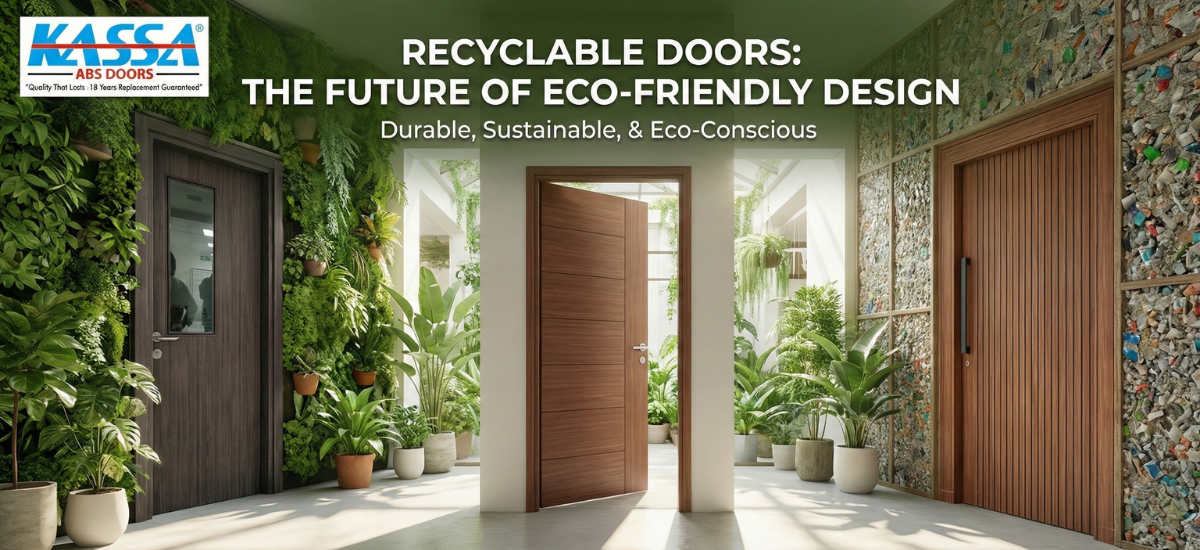
The construction industry is standing at a crossroads. For decades, the mantra was “build fast and cheap,” leading to a legacy of deforestation and overflowing landfills. But as we navigate the environmental challenges of the 21st century, the focus has shifted to “build smart and sustainable.” Architects, developers, and homeowners are no longer just asking how a door looks; they are asking where it came from and, more importantly, where it will go when its life is over. The era of disposable architecture is ending, and the era of recyclable doors is beginning.
In the past, the choice was often between natural wood (which requires cutting down trees) or cheap composites (which are filled with toxic glues and end up as permanent waste). Neither option is truly sustainable. This is where Acrylonitrile Butadiene Styrene (ABS) changes the game.
At Kassa ABS Doors, we believe that true luxury is responsible luxury. We have engineered a product that not only withstands the elements but also respects the planet. In this comprehensive guide to sustainable construction, we will explore why ABS is the superior green choice, how it contributes to eco-friendly interior design, and why it is the preferred material for green building certifications like LEED and IGBC.
The Material Truth: What Makes a Door Recyclable?
To understand why Kassa doors are sustainable, we must first understand the science of the material. Not all plastics are created equal.
Thermoset vs. Thermoplastic
Most synthetic building materials (like certain fiberglass composites or cross-linked PEX) are “Thermoset” plastics. Think of them like a baked cake; once they are formed, you cannot un-bake them. If you heat them, they burn. They cannot be recycled.
ABS, however, is a Thermoplastic.
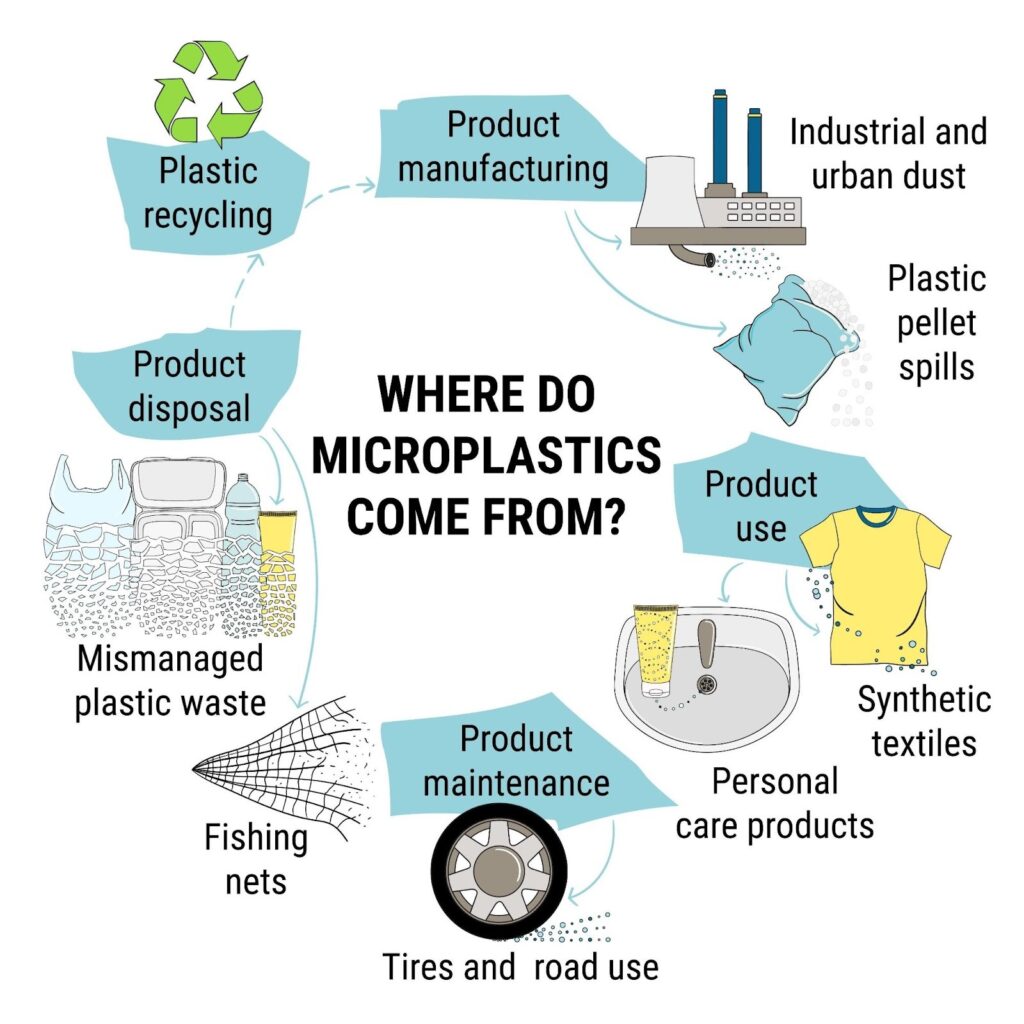
Think of it like candle wax. You can melt it, mold it into a shape, let it cool, and then melt it again to form a completely different shape. This property allows ABS to be recycled repeatedly without significant degradation of its polymer chains.
Recycling Code 7
In the global plastic coding system, ABS falls under “Other” (Code 7). While this category is broad, industrial ABS is highly sought after in the recycling stream. Post-consumer or post-industrial ABS doors can be shredded, melted down, and extruded into new pellets. These pellets can then be reborn as:
- New door components.
- Automotive parts (bumpers/dashboards).
- 3D printing filaments.
- Piping systems.
When you install recyclable doors from Kassa, you are installing a material that never needs to become trash. It is a resource banking system—the door you use today could be the car bumper of tomorrow.
Forest Conservation: The Zero-Wood Advantage
The most direct environmental impact of choosing ABS is the preservation of our forests.
The Timber Toll
India’s demand for teak, sal, and rosewood has decimated local forests and driven illegal logging in Southeast Asia and Africa.
- A single standard wooden door requires a significant amount of timber, often from trees that are 50-80 years old.
- Even “engineered wood” or plywood requires wood veneers and wood dust, contributing to the demand chain.
The Kassa Alternative
Kassa ABS doors are 100% wood-free in their surface and primary structure. By choosing ABS, you are effectively voting to keep trees in the ground.
- Carbon Sequestration: Living trees absorb CO2. By not cutting them down for joinery, we allow them to continue fighting climate change.
- Biodiversity: Protecting forests preserves the habitats of countless species.
For homeowners who love the look of wood but hate the guilt of deforestation, Kassa offers the perfect compromise. Our high-definition wood grain textures allow for eco-friendly interior design that looks natural but is technologically superior. You can see the variety of these nature-inspired finishes in our guide on what are the best colors for a plain door.
Durability: The First Pillar of Sustainability
There is a saying in the green building movement: “The most sustainable product is the one you don’t have to replace.”
Recyclability is the end-of-life benefit, but Durability is the during-life benefit.
- The Disposable Door Problem: Cheap flush doors or low-quality PVC doors often warp, crack, or rot within 5-7 years. They are then ripped out and thrown into a landfill.
- The Kassa Lifespan: An ABS door is engineered to last 20-30 years or more. It is waterproof, termite-proof, and impact-resistant.
By installing a door that lasts three times longer than a competitor’s, you reduce the manufacturing footprint, transportation emissions, and installation waste by a factor of three. This longevity is crucial for the “Lifecycle Assessment” (LCA) of a building. For a deeper dive into why toughness equals eco-friendliness, read our article on why durable doors matters.
LEED and Green Building Certifications
For architects and developers working on large-scale commercial or residential projects, sustainability isn’t just a moral choice; it’s a certification requirement. Systems like LEED (Leadership in Energy and Environmental Design) and IGBC (Indian Green Building Council) award points for sustainable material choices.
Kassa ABS doors can contribute to several credits, particularly under the Materials and Resources (MR) category.
1. Building Product Disclosure and Optimization
By using LEED certified door materials (or materials that meet the criteria for recyclability and non-toxicity), developers gain points. ABS is free from many of the Red List chemicals found in treated lumber (like arsenic in pressure-treated wood).
2. Construction and Demolition Waste Management
Since ABS is recyclable, waste generated during installation (cut-offs) or future demolition can be diverted from landfills and sent to recycling facilities. This contributes to waste diversion goals.
3. Indoor Environmental Quality (IEQ)
As discussed in our health-focused blogs, ABS is a low-VOC material. It does not require on-site painting or polishing, which improves the indoor air quality for the occupants. This is a significant factor in achieving IEQ credits.
The “Greenwashing” of WPC and Engineered Wood
The market is flooded with products claiming to be “Green.” It is important to scrutinize these claims.
Wood Plastic Composite (WPC):
- The Claim: It uses recycled plastic and wood dust.
- The Reality: While it uses waste, the mixture of organic wood fiber and plastic is often difficult to recycle at the end of its life because separating the two materials is energy-intensive. Furthermore, WPC can be heavy and brittle.
Engineered Wood (MDF/HDF):
- The Claim: It uses fast-growing trees.
- The Reality: The binders used to hold the wood fibers together often contain Formaldehyde, a known carcinogen. They are rarely recyclable and disintegrate in landfills, releasing chemicals into the soil.
The ABS Difference:
Kassa ABS is a pure, homogenous polymer system. It is cleaner to produce, safer to use, and easier to recycle. For a direct comparison of these materials, refer to our detailed analysis on 9 factors to consider between wooden vs abs doors.
Energy Efficiency: The Thermal Advantage
Sustainability also involves energy consumption. A drafty door that lets air conditioning escape is an environmental liability.
- Insulation: The honeycomb core structure of Kassa doors acts as a thermal insulator. It traps air, preventing heat transfer.
- Sealing: Because ABS doors are dimensionally stable (they don’t warp in monsoon or shrink in summer), they maintain a tight seal with the frame year-round.
This means your AC works less to keep the room cool, reducing your home’s carbon footprint and your electricity bill. This thermal efficiency is a key component of eco-friendly interior design.
Manufacturing Ethics: Made in India
Sustainability is also about “Food Miles” or, in this case, “Door Miles.” Importing timber from Africa or finished doors from China generates a massive carbon footprint due to shipping.
Kassa is proud to be a homegrown brand. By manufacturing locally, we:
- Reduce Emissions: Minimize transportation distances.
- Support Local Economy: Create green jobs in India.
- Ensure Compliance: Adhere to strict Indian manufacturing and labor standards.
Choosing a local manufacturer is a simple way to boost the sustainability profile of your project. Learn more about our origins and standards in Kassa ABS doors India top door manufacturers.
The Aesthetics of Sustainability
There was a time when “eco-friendly” meant ugly. Recycled products looked rough, beige, and unfinished.
Kassa shatters this stereotype. We believe that for sustainability to be widely adopted, it must be aspirational.
- Design Versatility: From sleek, modern minimalism to rich, traditional wood grains, our doors fit any aesthetic.
- Premium Feel: The weight and texture of our doors rival premium hardwood.
You do not have to sacrifice style to save the planet. You can have a high-gloss, designer door that acts as a centerpiece for your living room while knowing it is a responsible choice.
A Circular Economy Case Study
Imagine a hotel renovation project.
- Scenario A (Traditional): The hotel rips out 500 wooden doors. They are painted with lead-based paints. They cannot be burned (toxic fumes) and cannot be composted (too many chemicals). They go to a landfill.
- Scenario B (Kassa ABS): The hotel removes 500 Kassa doors after 25 years. These doors are collected by a specialized recycler. The hardware is removed. The ABS is shredded, melted, and turned into piping for the hotel’s new irrigation system.
This is the Circular Economy. It is a system where waste is designed out of the cycle. By choosing recyclable doors, you are participating in this virtuous circle.
Conclusion: Building a Legacy
When we build a home or an office, we are building a legacy. That legacy should not be a pile of non-degradable waste in a landfill.
The choice of a door seems small, but multiplied by the millions of homes in India, the impact is massive. By switching to Kassa ABS, you are helping to:
- Save millions of trees.
- Reduce construction waste.
- Lower energy consumption.
- Eliminate toxic VOCs.
Sustainability is no longer a niche; it is the new standard. Whether you are an architect chasing LEED certified door materials or a homeowner who wants to leave a better planet for their children, Kassa ABS doors offer the solution.
Choose strength. Choose style. Choose the future.
Build responsibly. Explore the sustainable, recyclable collection at Kassa Doors today.