Table of Contents
Introduction
In the high-stakes world of institutional infrastructure, a door is never just a door. In a luxury hotel, it is the guardian of a guest’s privacy and sleep. In a bustling hospital, it is a critical barrier against infection and a shield against chaos. For architects and facility managers, meeting the rigorous hospital doors specifications India demands is becoming increasingly difficult with traditional materials like wood or painted metal.
The old standard of using flush doors with laminates is failing. They chip under the impact of stretchers, they swell when exposed to aggressive cleaning fluids, and—most dangerously—they harbor bacteria in their porous grains. This realization has triggered a massive shift in the Indian B2B market. Leading healthcare providers and hospitality chains are moving away from timber and towards Acrylonitrile Butadiene Styrene (ABS).
At Kassa ABS Doors, we are at the forefront of this transition. We understand that for a hospital administrator or a hotel general manager, the priority is the “Triad of Performance”: Hygiene, Durability, and Acoustics. In this industry-focused guide, we will explore why ABS technology is uniquely engineered to exceed the standards set by NABH (National Accreditation Board for Hospitals) and global hospitality ratings, offering a solution that is as safe as it is stylish.
The Infection Control Mandate: Hygiene First
The aftermath of the global pandemic has rewritten the rulebook for facility management. The phrase “high-touch surface” is now a red flag. In a hospital environment, doors are the most frequently touched surfaces, making them potential vectors for Hospital-Acquired Infections (HAIs).
When architects review hospital doors specifications India, the first criterion is “cleanability.”
The Problem with Wood and Laminates
Wood is organic. Even when treated, it retains a level of porosity.
- Micro-Cracks: Over time, painted or varnished wood develops microscopic cracks due to thermal expansion.
- Bacterial Harbor: These cracks trap moisture and organic matter, creating a breeding ground for bacteria like MRSA or E. coli.
- Delamination: In high-humidity zones (like patient bathrooms), laminates peel off, exposing the raw wood beneath to fungal growth.
The ABS Advantage: True Antibacterial Doors
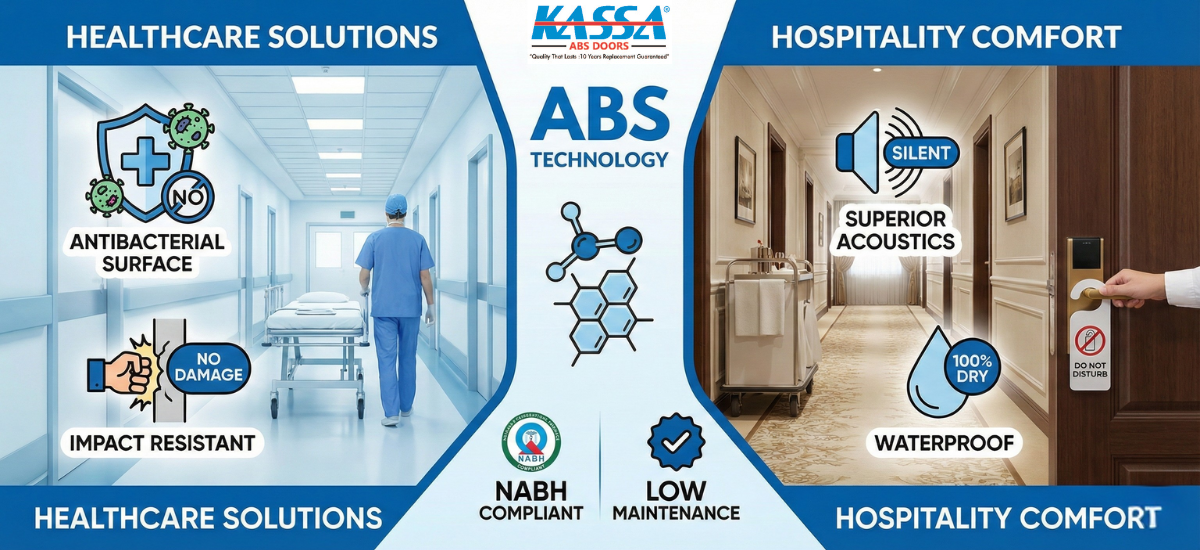
Kassa ABS doors are inherently inorganic and non-porous.
- Hydrophobic Surface: The ABS sheet repels water and fluids.
- Seamless Construction: Vacuum-bonded skins do not peel.
- Chemical Resistance: Can withstand disinfectants like bleach and quats without surface degradation.
For institutions looking for antibacterial doors, ABS offers a passive defense system that works 24/7 to keep pathogen counts low.
Impact Resistance: Surviving the “Stretcher Test”
If hygiene is the silent battle, physical abuse is the loud one. Walk through the corridors of any busy AIIMS or Apollo hospital, or the service elevators of a Taj or Marriott, and look at the bottom half of the doors. They are usually battered.
The Logistics of Care
Hospitals:
- Gurneys
- Wheelchairs
- Crash carts
- IV poles
Hotels:
- Luggage trolleys
- Housekeeping carts
- Room service tables
Traditional wooden doors dent and splinter. Painted metal doors scratch and rust.
The Science of Butadiene
Butadiene gives ABS doors elasticity and impact toughness.
- The material absorbs shock.
- It flexes without cracking.
- It returns to its original shape.
This resilience allows Kassa doors to meet demanding hospital doors specifications India without requiring metal kick plates.
The Hospitality Challenge: Acoustics and Privacy
Guests paying premium rates expect quiet rooms, but hotel corridors are noisy. The search for hotel room doors soundproof features often leads to heavy fire doors.
ABS provides a balanced solution.
The Honeycomb Dampener
The honeycomb core structure:
- Breaks up airborne sound waves
- Reduces vibration transfer
- Minimizes corridor noise entering the guest room
Hotels using ABS doors achieve better sound ratings and higher guest satisfaction.
Aesthetics: Moving Beyond the “Clinical” Look
Traditional durable doors looked industrial. ABS changes that.
The Warmth of Wood, The Strength of Polymer
Kassa ABS doors can replicate:
- Premium wood textures
- Calming tones for patient rooms
- Modern finishes for luxury hotels
You gain durability without losing design.
Operational Expenditure (OpEx): The Financial Case
For institutions, maintenance costs can exceed purchase costs.
The Maintenance Trap of Wood
- Polishing every 2–3 years
- Chipping paint that releases VOCs
- Frequent replacement of bathroom doors
The “Fit and Forget” Savings
Kassa ABS doors:
- Never require polishing or painting
- Are 100% washable
- Last decades without degradation
Across 100–500 rooms, the savings are enormous.
Regulatory Compliance: NABH and Fire Safety
NABH standards require:
- Non-porous, cleanable surfaces
- Termite-free materials
Kassa ABS meets and exceeds these requirements. Reinforced cores also support safety hardware like panic bars and hydraulic closers.
Water Resistance in Wet Areas
Hospitals and hotels both struggle with bathroom door rot.
ABS solves this with:
- 100% waterproof sheets
- No swelling
- No mold risk
Customization for Institutions
Kassa offers:
- Vision panels for ICU and OT rooms
- Louvers for ventilation
- Extra-wide doors for accessibility
- Custom colours and textures
Conclusion: The New Standard of Care
The healthcare and hospitality industries are evolving. Infrastructure must evolve too.
Old hospital doors specifications India relying on plywood and laminates are no longer safe or economical. ABS is the future.
Kassa ABS doors deliver:
- Hygiene
- Durability
- Acoustics
- Zero maintenance
- Long-term savings
Whether you run a 500-bed hospital or a luxury hotel chain, ABS is the modern benchmark.
Equip your facility with the best. Contact Kassa Doors for a B2B consultation and bulk specifications.